


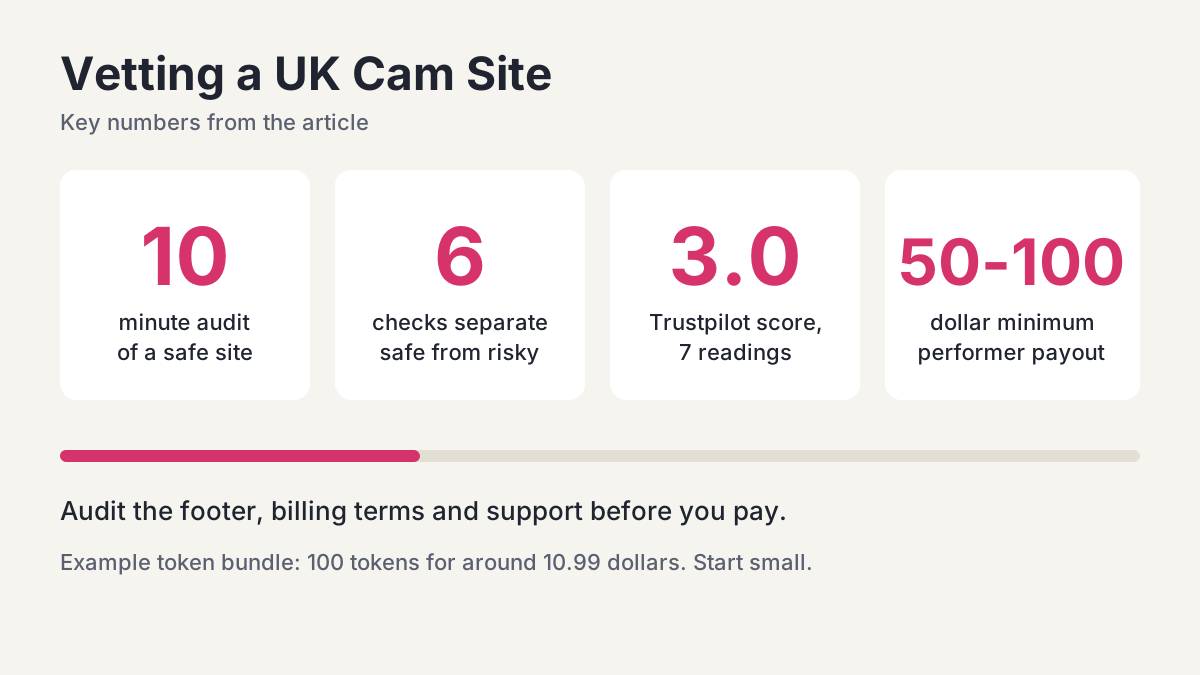
A safe cam site for UK users is one you can audit in ten minutes: a named operating company, clear billing descriptors, verified performers and a cancellation route that does not need a support ticket. Most guides skip that audit and rank sites by bonus size. That is backwards. A 50 percent token bonus means nothing if the charge appears on your statement under a name you do not recognise, and you spend two weeks arguing with your bank.
Our own tracking of StreamRay since 27 August 2026 shows a Trustpilot score steady at 3.0 across 7 readings. The brand page lists the UK operator as Wight Enterprise Limited, based in Reigate, Surrey. Those two facts are a useful template for what to look for on any site.
Why the top search results will not help you
Search for this topic and you find a Trustpilot category page about public meeting rooms, a ranking built around a single bonus, and a listing page that mixes cam sites with unsecured CCTV feeds. None of them explain how to judge a site. That gap matters because adult cam platforms look similar on the surface. Same grid of thumbnails, same coloured buttons, same promise of free chat.
Underneath, they differ sharply. Some are run by identifiable companies with UK or EU addresses. Others hide behind a shell name and a contact form. The difference decides whether you can get a refund, whether your data is handled lawfully, and whether the performers you watch are consenting adults. So skip the star rankings and run your own comparison.
The six checks that separate safe from risky
Start with the footer. A legitimate site names its operating company and gives a registered address. Click through and search the company name on Companies House if it claims to be British. If the footer shows nothing but a copyright line, treat that as a warning.
Next, look for the record-keeping statement. US-linked platforms publish an 18 U.S.C. 2257 compliance notice confirming that performer ID and age records are held. StreamRay carries one. It does not guarantee good behaviour, but its absence suggests a site is not documenting who appears on camera.
Third, check age verification on the viewer side. The UK's Online Safety Act pushes adult sites toward real age checks, with methods ranging from card checks to ID upload and facial age estimation. A site that lets anyone tick an 18+ box and enter is behind where UK regulation is heading, and may be a poor bet for your data too.
Fourth, read the billing terms before registering. Look for the descriptor that will appear on your bank statement, the cancellation process, and whether tokens expire. Many platforms run on a token system, where you buy a bundle, for example 100 tokens for around 10.99 dollars on typical sites, and spend it on tips and private shows. Tokens have no value outside the site, so never buy a large bundle on day one.
Fifth, find out how the site treats performers. A fair platform pays on a fixed schedule, weekly or bi-weekly, with a minimum payout of roughly 50 to 100 dollars. Unhappy performers leave, and a site that churns through its roster usually has billing or conduct problems that reach viewers too.
Sixth, test support before you need it. Send a pre-sale question and time the reply. A response inside a day suggests a staffed team. Silence suggests a mailbox nobody reads.
Reading reviews without being fooled
A star score hides more than it shows. StreamRay sits at 3.0 on Trustpilot across a small number of reviews, which tells you the sample is thin and that the score could swing quickly. Do not average your way to a verdict. Sort by most recent, then read the one-star and five-star reviews side by side.
Look for patterns. One angry review about a lost password is noise. Five reviews in a month describing the same unexpected charge is a signal. Common viewer complaints across the cam industry include chargebacks and disputed purchases, fake or stolen-photo profiles, hidden fees on private shows, and bots posing as chat users. If a site's complaints cluster around billing, be strict with your own spending limits.
Treat glowing reviews with equal suspicion. Reviews that all use the same phrasing, arrive in a burst, or praise the site without mentioning any actual feature are usually prompted. A real review tends to mention a specific moment: a slow stream, a refund that took four days, a performer who answered a question.
For deeper reading on one platform, our write-ups on whether StreamRay is safe and the StreamRay complaints we have tracked show what this kind of review audit looks like in practice.
What I learned from paying for the education instead of the tokens
Last October I spent around 150 pounds on a six-week coaching programme for cam performers. I expected tips on lighting and scheduling. What changed my thinking was the idea that commercial success and authentic self-expression are not opposites. A performer who sets firm boundaries tends to run a more stable stream and attract viewers who respect the rules.
That lesson carries over to viewers choosing a site. Platforms that protect performer boundaries, with verified IDs, report tools and fair payouts, also tend to protect viewer billing. The same operational discipline shows up on both sides. When a site is sloppy with performers, it is rarely careful with your card. I now read a site's performer-facing pages before I judge its viewer-facing ones, and it has saved me from several sites that looked polished but were not.
Geo-blocking, VPNs and why UK users get different results
Some platforms restrict access by region. Reasons include licensing gaps, payment processor limits and local obscenity rules. If a site shows a message like "content not available in your region", that is geo-blocking, and it usually relies on IP lookup databases.
Do not respond with a VPN. Many sites detect VPNs, and payment systems flag mismatches between your card country and your IP. A mismatch can freeze an account or trigger a failed charge. If a site blocks the UK, pick another one rather than working around it. A site that serves UK customers openly is also the one bound by UK consumer and data rules.
A small-spend test before you commit
Treat the first session as an experiment. Create an account with a unique password and a dedicated email address. Buy the smallest token pack, around 10 pounds. Spend a few tokens, then check three things within 48 hours: did the statement descriptor match the site, did a receipt arrive, and can you find the cancel and delete-account options without contacting anyone.
If all three pass, scale up slowly. If any fails, stop. Chargeback rights through your card issuer are your safety net, so keep screenshots of the purchase page and any chat with support. For a worked example of the whole process, see our StreamRay review, and for the money side, our notes on how payouts and charges work.
How a safe site compares on the points that matter
The table below turns the six checks into a quick scorecard you can copy for any platform you are weighing up. Fill it in with what you actually find in the footer, terms and reviews, not with what the homepage promises.
| Check | What a safe site shows | Red flag |
|---|---|---|
| Operator | Named company and registered address | Copyright line only |
| Performer records | 2257 statement or equivalent | No compliance notice |
| Age checks | Card, ID or age estimation | Tick-box entry |
| Billing | Clear descriptor, easy cancellation | Vague terms, expiring tokens |
| Support | Reply within a day | No reply at all |
If you want to see how a sister brand handles the same checks, GirlsWay is run in the same network and can serve as a second reference point. Apply the identical scorecard and compare the answers side by side.
Comments
No comments yet.
Leave a comment
Your email will not be shown. Comments are reviewed before they appear.